
Another Country
Rupert Everett's Short-Lived Pop Music Career
While going through old music publication archives, I learned of the existence of actor Rupert Everett’s short-lived pop music career. (I delved into Tim Curry’s music career a few months ago.) Unlike Curry’s oeuvre, I was entirely unaware that Rupert Everett had released a pop single (technically, it looks like he released two) until I came across this blurb in an August, 1987 edition of the radio tip sheet Hard:
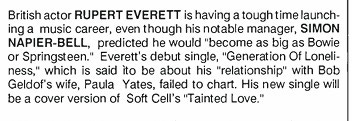
Simon Napier-Bell was the man behind Wham! I couldn’t resist looking this single up. If you’re looking for a William Shatner “Golden Throats” moment, you won’t find it. It is disappointingly competent.
In fact, if I did not know the singer as a movie actor, I would probably just view this as quite a good lost 80s single. It sounds like it could have been a hit, and with a successful manager and a singer with an already famous name (not to mention a beautiful face), it surprises me a bit that it didn’t at least squeak into the lower reaches of the top 100.
The 1984 film Another Country had given Everett a high profile in the UK, and an art house following in the US. He worked steadily, but he had not yet achieved the massive rom com fame that would come with 1997’s My Best Friend’s Wedding. He was bothered, he told the Independent, by the way he was portrayed in the British press. “All anyone seems to say about me is: privileged, toff, lucky.” In fact “arrogant” and “cocky” are words that the press most loved to attach to him. Many entertainment writers wondered if the young man would live up to his obvious “promise.”
An article at this time in The Evening Standard by Linda Franklin spent four columns psychoanalyzing the 26-year-old actor, explaining that his surface arrogance masked deep insecurity.
Music, the article said, was Everett’s first love. He played four instruments “to examination standard” and was set for a career as a concert pianist when he was sidetracked by theater.
Everett wrote “Generation of Loneliness” while he was filming the Bob Dylan vehicle Hearts of Fire. The movie might have served as a convenient bridge to a musical career. In fact, Everett told The Independent that this was a major reason he took the role. Everett had two songs on the soundtrack, but the film bombed commercially and critically.
Vocally, on this single Everett channels Bowie. In the opening verse it sounds almost like an impersonation. Perhaps audiences who would respond to that vocal delivery were more interested in getting tickets for the real Bowie’s 1987 Glass Spider tour.
I was working at McDonalds in 1987— my senior year of high school— and someone came through the drive through saying he had two extra tickets to go see Bowie that evening. I didn’t take them. I would have had to go straight from work in my McDonald’s uniform, and I just couldn’t switch mental gears that fast. It’s one of my musical regrets. (I wrote about another one recently.) Who would have been watching me to care that I was in my work clothes? Oh well. I’ll be more spontaneous in my next life. But I digress…
While the Bowie-esque vocal stylings might put the song in the indie/college music space, it also has jangle pop guitars and big 80s production and an uplifting message about holding on while living through an alienating and lonely time. At the end of a successful 80s teen comedy it feels like it could have occupied the cultural space of a Simple Minds song.
The existence of the single got more press than a random musician’s first single would have, but I unearthed few actual reviews. The Manchester Evening News concluded that the song “isn’t half bad as long as you don’t have to watch the stick insect-like actor perform it.”
The press was overall more skeptical than either negative or glowing. “Why is he doing this?” was the overall tone.
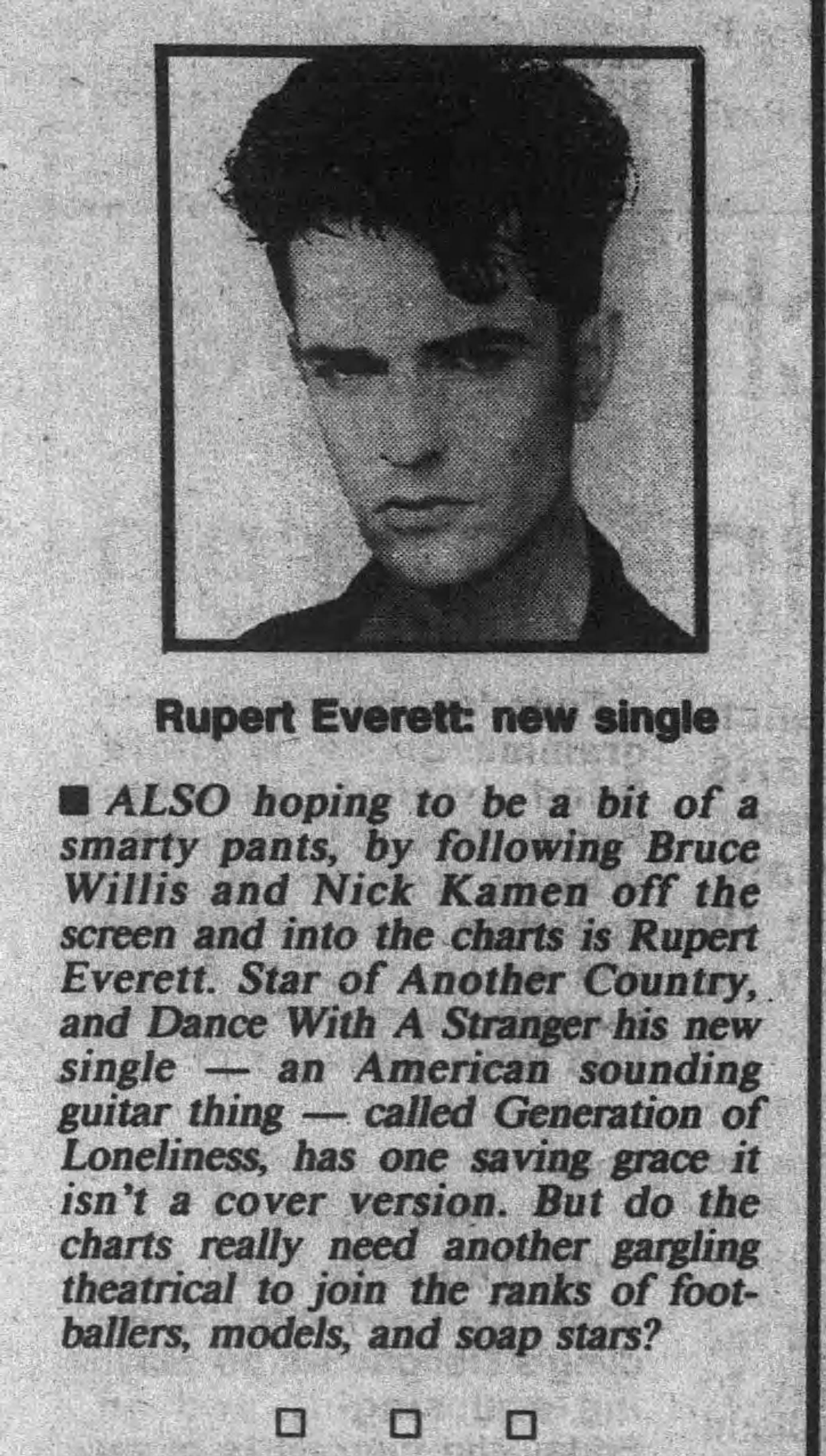
The press at the time said that Everett’s next single would be a cover of Soft Cell’s “Tainted Love” and that an album was on the way. Neither of these predictions came true. There was one more single called Into the Vortex, released in France in 1989. It was a moodier, Depeche Mode style synth pop track with a spoken narration at the end. It has a dance club aesthetic. (My instinct is that it might have been more successful if the narration and the Depeche Mode-ish parts were more integrated and less separate.) There is very little information out there about this recording, but it does show up in Discog and on Youtube.